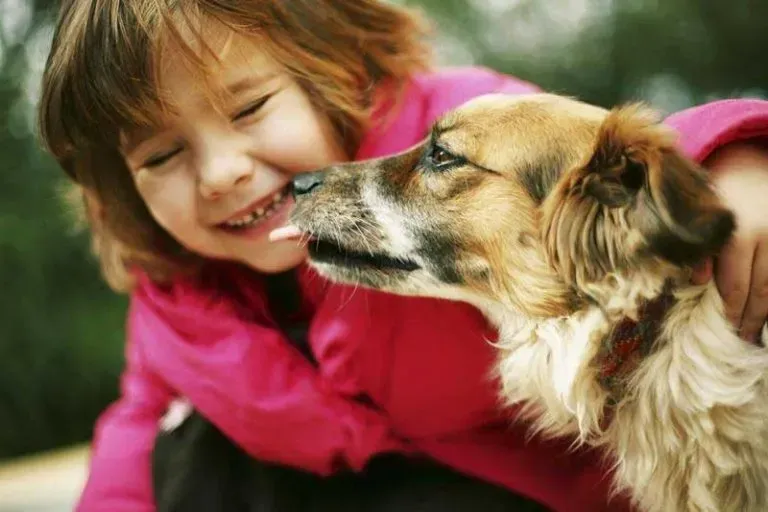
There’s nothing cuter than kids and dogs running around, playing, and sleeping together. In general, kids love dogs and dogs love kids, which is why the Internet is full of heartwarming stories about loyal dogs and the lengths they will go to for their little human friends. However, there is always a risk that you need to be aware of when you have dogs and kids in the same room.
Recently,
the staff at Ambassador Animal Hospital
came across a viral video that featured a 3-4 year old little boy repeatedly pulling on a dog’s tail and fur, hitting the dog, trying to ride the dog, and getting in the dog’s face—while several adults off-camera laugh and record the antics. Although this may seem like nothing more than mischievous fun, and although the incredibly patient dog was large enough that he probably wasn’t really being hurt by the child, the truth is that allowing this kind of behavior toward dogs is dangerous.
Perhaps you’ve seen similar behavior in your own circle of friends and family, or perhaps you’ve seen children run up to pet a strange dog at the park without checking in with the owner first. Or, maybe you’ve been the dog owner who has had to remind kids to slow down and allow your dog to greet them before sticking their hands out to pet your dog. Of course, if you own a dog who is going to be around kids, it’s important to
train your dog how to behave toward children—but it’s equally important to teach your children the proper way to interact with dogs, not only for the animal’s comfort and safety, but for theirs.
Tips For Promoting Safety Between Kids and Dogs
Most kids are fascinated by animals and want to play with them and pet them, and most kids don’t naturally understand how to be gentle. Being too rough with a kitten or another small pet is dangerous for the animal, but being too rough with a dog is dangerous for the child. Here are our top recommendations for ensuring that your kids understand how to safely interact with dogs:
Keep Kids SAFE.
One of the best ways to ensure that both your kids and your dogs are comfortable around each other and to prevent dog bites or other incidents it to teach your children the acronym: SAFE. All kids should know that they should never approach a dog that is Sleeping, Angry, Fearful, or Eating. This is common sense to adults—but it’s not common sense for children, who have fewer personal space boundaries. Studies show that most accidents between children and dogs happen in one of these scenarios. Teach your kids that dogs are very much like humans, and they don’t like it when people pet or hug them while they’re sleeping (it startles them and they may respond by snapping!), if someone tries to pet, hug or restrain them when they are angry or afraid, or if someone gets between them and their food.
Don’t Approach Strange Dogs Without Permission.
Another aspect of dog safety and bite prevention that you should teach your children is how to approach dogs that they don’t know. Make sure your kids understand that they must always ask the owner’s permission before running up and petting a dog that is out on a walk, or on leash—and even when they get permission, they should approach slowly and carefully.
Develop Positive, Proactive Habits.
Ultimately, the best way to ensure that your kids and your four-legged family member have positive interactions is to promote good bonding between them. While you should never leave young children unattended with a dog, you can start early building trust and developing a strong relationship between the two by adopting a few simple practices:
Teach Kids to Stand Like a Tree
You’ve probably seen children and dogs interacting before—typically, the dog gets excited about the presence of a child and starts jumping, wagging its tail, or nipping. Depending on the size of the dog, this can be very frightening for a kid. When introducing a new dog, teach your children to become a tree: stand still, fold your hands in front, look at your roots (feet), and ignore the dog or puppy that is getting too frisky. Unless children are taught this behavior, they will respond by running away, screaming, yelling “No!” or pushing the dog away, which will either make the dog more excited or make the dog frightened. In either case, the response makes injury to the child more likely. Kids who are “being a tree” become boring to the dog, who will soon give up seeking their attention.
Teach Kids How to Deliver Treats
Another common cause for dog bites or other injuries and accidents is treat-giving. Teaching your child how to best give treats to your dog will eliminate a potential source of stress for both the child and the dog. Try teaching with a stuffed animal first before allowing your child to give a treat to your dog: Kids should always place the treat on the ground, toss the treat, or offer the treat with an open hand. Make sure that your kids know that they should never tease a dog by withholding the treat or hold a treat over their heads to make the dog jump for it—both of these situations could easily end in a bite or other injury.
Use Training Games
There are a number of great training games for your dog that you and your child can practice together. Try games like fetch, stay inside the rope, and hide-and-seek to start. When your dog follows the rules of the game, reward your dog with a treat. For example, if you are teaching your dog to fetch, the basic rules are that the dog returns the item to you and then waits for the next throw. It’s important to teach your kids that if the dog tries to tug the item back or doesn’t return the item, they should quit playing and ignore the dog for a while—if they get into a tugging or chasing match, the dog may become overly excited and a bite or other injury could be the result. If you are investing in training for your dog, ask your trainer if you can bring your children to a couple of the sessions as well.
Teach Kids How to Interpret Body Language
Dogs who are seeking and enjoying affection react in similar ways, while dogs who are not enjoying an interaction will show similar signs of distress. Some dog body language, such as curling lips, bared teeth, or flattened ears, may be obvious for grown-ups, but could be lost on children. There are also more subtle signs that you can teach your children. You know that a dog who comes back for more when you stop or who leans in while you are petting is appreciating the affection. Any dog who turns away, tries to leave, yawns, or shows a half moon of white in his eye is not enjoying the interaction. If your dog does a big shake-off when the interaction is over, this may also indicate that the affection was not appreciated. In general, you should teach your children to allow dogs to seek interaction from them rather than trying to force interaction on the dog.
Ensuring that your kids are safe and comfortable around dogs takes work, but the results are worth it—especially if you are building a relationship between children and a family pet. Over time, kids and dogs who learn how to respect and understand one another can create strong bonds of love and treasured, long-term relationships.